
How to Build a Sales Funnel That Doesn't Quit After One Week
Why Your Sales Funnel Long Term Strategy Determines Whether You Grow or Plateau

A sales funnel long term strategy is the difference between a business that wins once and one that keeps winning — turning strangers into buyers, and buyers into loyal advocates who come back and refer others.
Quick answer: What makes a sales funnel work long term?
Go beyond the transaction — treat the funnel as an ongoing relationship, not a one-time conversion event
Nurture at every stage — guide prospects from awareness through loyalty with relevant, helpful content
Personalize the experience — segmented, behavior-triggered communication builds trust faster
Measure what matters — track retention, lifetime value, and pipeline velocity, not just closed deals
Use the right tools — CRM, automation, and AI keep your funnel running even when you're not
Here's why this matters more than most small business owners realize.
Most sales funnels are built to close one deal. They're designed around a push — get the lead, make the pitch, collect the payment. But that approach ignores what happens after the sale, and that's exactly where the real money is. Increasing customer retention by just 5% can grow profits anywhere from 25% to 95%. The chance of selling to an existing customer is 60–70%, compared to just 5–20% for a new one. Yet most businesses keep pouring budget into top-of-funnel acquisition while their existing customers quietly drift away.
The businesses that grow consistently aren't just building funnels. They're building systems — ones that stay relevant, stay helpful, and stay in front of the right people over months and years.
I'm Carlos Cortez, senior consultant at S9 Consulting and a revenue-growth strategist with over two decades of experience building scalable sales and marketing systems across SaaS, e-commerce, and technology businesses — including scaling a distribution company from zero to $18M by designing its core sales infrastructure from the ground up. My entire career has been shaped by understanding how a sales funnel long term creates compounding growth rather than one-time wins, and that's exactly what this guide is built around.

Understanding the Sales Funnel Long Term: Beyond the Transaction
When we talk about a sales funnel long term, we are moving away from the traditional "leaky bucket" model. In the old way of doing things, you poured leads into the top, shook them until a few coins fell out the bottom, and ignored the rest. Today, in May 2026, that approach is not just inefficient—it’s expensive. The cost of acquiring a new customer can be five times higher than retaining an existing one.
Instead, we advocate for what we call a Relationship Funnel. This is a buyer-centric model that prioritizes the way customers want to buy rather than how the business wants to sell. While a traditional funnel uses psychological pressure tactics to force a "yes," a relationship funnel focuses on trust-building and emotional connection.

At S9 Consulting, we focus on the "Return on Relationship" (RoR). This metric measures the value accrued from loyalty, referrals, and long-term engagement. Relationship-based growth can increase lifetime value by a staggering 300%. To learn more about the basics, check out our guide on What Are Sales Funnels.
The Shift from Pressure to Partnership
Long-term success requires ditching the "always be closing" mentality for an "always be helping" approach. Modern consumers are savvy; they can smell a high-pressure tactic from a mile away. Instead, we use:
Value-adding content: Providing insights that solve problems before money ever changes hands.
Contextualized engagement: 63% of smartphone users are more likely to buy from companies that offer relevant recommendations based on their specific interests.
Long-term loyalty: Shifting the goal from a single transaction to a decade-long partnership.
The 7 Stages of a Sustainable Customer Journey
To build a sales funnel long term, you need to map out every touchpoint. It isn't just Awareness, Interest, and Sale anymore. The journey is non-linear and requires a more nuanced map.
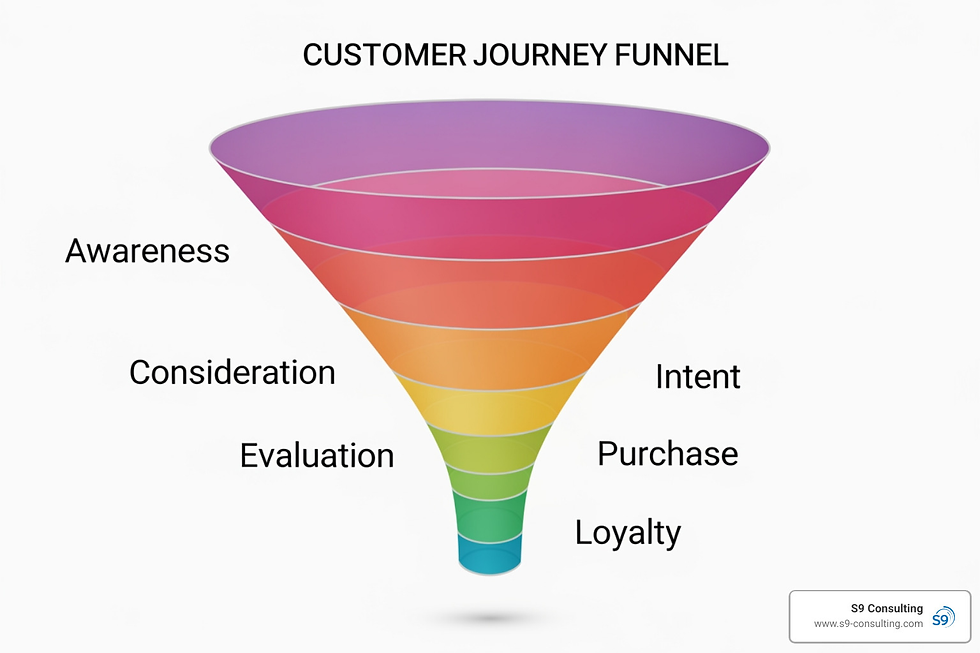
Awareness: The prospect realizes they have a problem.
Interest: They begin looking for solutions and find your brand.
Consideration: They compare you against others.
Intent: They take an action that signals they are ready to buy (like a demo request).
Evaluation: The final check of ROI and fit.
Purchase: The initial transaction.
Loyalty and Retention: The stage where the real profit happens.
Mapping these stages correctly is vital for any business in Boston or Jacksonville looking to scale. For a deep dive into this process, see our Slugcomplete Guide To Map Out Sales Funnel.
Nurturing Leads Through the Evaluation Phase
The "Evaluation" phase is often where deals go to die. Research shows that 95% of customers choose a company that provides them with sufficient content to navigate each stage of the buying process. Most customers need to hear your company's claims 3 to 5 times before they actually believe them.
Companies that make buying easy are 62% more likely to win a high-quality sale. This means removing friction, providing clear Sales Funnel Mapping, and ensuring your team acts as advisors rather than just order-takers.
Strategic Management for Complex B2B Cycles
In the B2B world, the sales funnel long term looks very different from B2C. We aren't just selling to one person; we're selling to a "buying committee" that typically includes 6 to 10 decision-makers. In complex enterprise deals, these cycles can last anywhere from 6 to 18 months.
Managing these long cycles requires "multi-threading"—building relationships with multiple people within the same organization so that if your primary "champion" leaves the company, the deal doesn't die with them. For those managing high-ticket deals, our Long-Cycle Sales Framework - Enterprise Revenue Guide 2026 offers a blueprint for success.
Strategies for a Sales Funnel Long Term in B2B Markets
To survive a 12-month sales cycle, you must shift from being a vendor to a strategic advisor. This involves:
Strategic Advisory: Delivering value through insights and ROI calculations long before a contract is signed.
Multi-quarter Nurture: Maintaining relevance over 18 months through a value-first cadence. You can't just send "just checking in" emails for a year; you need to provide new data, case studies, and industry trends.
Designing Playbooks for Multiple Buyers
Your funnel content must speak to different personas simultaneously:
User Buyers: Focus on ease of use and daily functionality.
Economic Buyers: Focus on ROI, budget, and bottom-line impact.
Technical Buyers: Focus on security, integration, and systems compatibility.
Using signal-based touchpoints (like a prospect visiting your pricing page three times in a week) allows you to react in real-time to interest, even during a long dormant period.
Future-Proofing with Technology and AI
By May 2026, AI has moved past being a "cool feature" to being a core requirement for funnel management. Agentic AI and predictive analytics allow us to manage thousands of relationships with the same level of care we used to give to just a few.
AI helps redefine the traditional funnel by predicting which leads are likely to close and which are likely to churn. As noted by AMA Boston, AI search has fundamentally changed how prospects find information, making top-of-funnel SEO more important than ever.
Leveraging AI for Sales Funnel Long Term Performance
We use AI to execute autonomous actions, such as real-time forecasting and automated deal progression. This technology ensures that 44% of consumers who say they will buy again after a personalized shopping experience actually get that personalization. AI can analyze past behavior to offer the exact recommendation a user needs at the exact moment they need it. To make sure you're focusing on the right areas, you should Prioritize Your Funnel Initiatives based on data-driven insights.
Automation and Segmentation Best Practices
The numbers don't lie: segmented email campaigns can see as much as a 760% increase in sales. Automation should be used to maintain "database hygiene" and trigger sequences based on behavior.
80% of business professionals believe email marketing increases customer retention.
59% of respondents say marketing emails influence their purchase decisions.
Behavior-triggered sequences ensure that a prospect receives a follow-up immediately after downloading a whitepaper, rather than three days later when they've forgotten who you are.
Measuring Success: KPIs for the Long Haul
You cannot manage what you do not measure. For a sales funnel long term, you need to look past simple conversion rates.
Metric | B2C Focus | B2B Focus |
Primary KPI | Customer Lifetime Value (LTV) | Account Velocity |
Retention | Repeat Purchase Rate | Churn Rate / Net Retention |
Efficiency | Cost Per Acquisition (CPA) | Pipeline Coverage (Target 6-8x) |
Engagement | Personalization Lift | Stakeholder Expansion |
To get these insights, you need a robust tracking setup. We recommend you Create A Conversion Funnel Report In Google Analytics 4 to visualize where people are dropping off over time.
Tracking Leading vs Lagging Indicators
Lagging indicators (like revenue) tell you what happened in the past. Leading indicators (positive signals) tell you what will happen in the future.
Leading Indicators: Website traffic, email open rates, number of discovery calls booked, and "account velocity" (how fast an account moves from awareness to intent).
Lagging Indicators: Closed-won revenue, average deal size, and annual churn.
Using multi-touch attribution is essential. If a customer saw a LinkedIn ad in January, read a blog post in March, and finally bought in June, a "last-touch" model would give all the credit to the June interaction, ignoring the months of work that actually built the trust.
Frequently Asked Questions about Long-Term Funnels
What is the difference between a sales funnel and a relationship funnel?
Traditional sales funnels often rely on volume and psychological "hacks" to pressure people into a quick purchase. They are seller-centric. A relationship funnel is buyer-centric; it focuses on providing value at every stage, building trust, and ensuring a seamless experience that leads to long-term loyalty and repeat business.
How long does a typical long-cycle sales funnel take?
It varies wildly by industry. A simple B2C purchase might take minutes, but complex B2B enterprise deals typically take 90 days to 24 months. Factors influencing this include the number of stakeholders (the "buying committee"), the total financial commitment, and the complexity of the systems integration required.
Why is customer retention critical for long-term funnel health?
Retention is the engine of profitability. Increasing retention by just 5% can nearly double your profits. Because it is much cheaper to sell to an existing customer (60-70% success rate) than a new one (5-20% success rate), a funnel that ignores post-purchase engagement is essentially leaving money on the table.
Conclusion
Building a sales funnel long term isn't a "set it and forget it" project. It’s a living system that requires constant refinement, the right technology, and a deep commitment to the customer relationship. At S9 Consulting, with our offices in Boston, MA and Jacksonville, FL, we specialize in helping businesses automate these processes and integrate their systems for maximum efficiency.
Whether you are looking for More info about sales funnel lead generation or you need a partner to help you build out a complex AI-driven CRM strategy, we are here to ensure your funnel doesn't just work for a week—it works for years.
Are you ready to stop chasing one-off sales and start building a relationship engine? Let's get to work.