

Stop Coding and Start Prompting Your Next Website
Updated: May 13
Web Design with AI Is Changing How Websites Get Built

Web design with AI lets you go from a text prompt to a fully structured, responsive website in minutes — no coding required. Here's a quick look at how it works:
Describe your site — Type a prompt explaining your business, style, and goals.
AI generates the layout — Structure, copy, colors, and fonts are created automatically.
Refine with edits — Use conversational commands or a visual editor to tweak details.
Add animations and effects — AI handles responsive behavior and motion across devices.
Publish in one click — No developer handoff needed.
Popular tools making this possible include Figma Make, TeleportHQ, Webflow AI, Elementor AI, and CodeDesign.ai — each with its own strengths depending on your workflow.
Not long ago, building a professional website meant hiring a developer, waiting weeks, and spending thousands of dollars. Then came drag-and-drop builders like Wix and WordPress, which lowered the bar — but still demanded time, templates, and a learning curve most small business owners don't have.
Now, AI has changed the equation entirely. You describe what you want, and the software builds it. What used to take days can happen in an afternoon. And the results are getting harder to distinguish from hand-crafted designs.
This is not a distant future — it's already here. Over 3.5 million websites have been built using AI-powered builders, and 85% of designers and developers believe AI is essential to their future success.
I'm Carlos Cortez, a senior technology and business consultant with over two decades of experience building digital infrastructure and scaling companies through technology — including designing and launching custom web platforms that drive real revenue. My hands-on work across e-commerce, SaaS, and automation gives me a grounded perspective on how web design with AI can be applied practically, not just theoretically.
In this guide, I'll walk you through everything you need to know to start prompting your next website — and actually get results.

The Evolution of Web Design with AI
The journey from hand-coded HTML files to modern web design with AI has been a evolution. In the early days, every pixel was fought for with lines of code. Today, we are entering the era of "Vibe Coding"—a term used to describe a design process driven by mood and intent rather than syntax and semi-colons.
AI isn't just a fancy template picker. Platforms like Figma Make allow designers to generate entire UI layouts from natural language prompts. This means you can say, "Create a minimalist landing page for a Boston-based fintech startup with a focus on trust and security," and the AI will assemble the hero section, feature grids, and contact forms in seconds.
For those of us in the agency world, this shift is revolutionary. We no longer spend forty hours on basic structural setup. Instead, we use Explore AI-powered design solutions to handle the heavy lifting of wireframing and style guide creation. This allows our team to focus on what actually matters: strategy, user experience, and conversion.
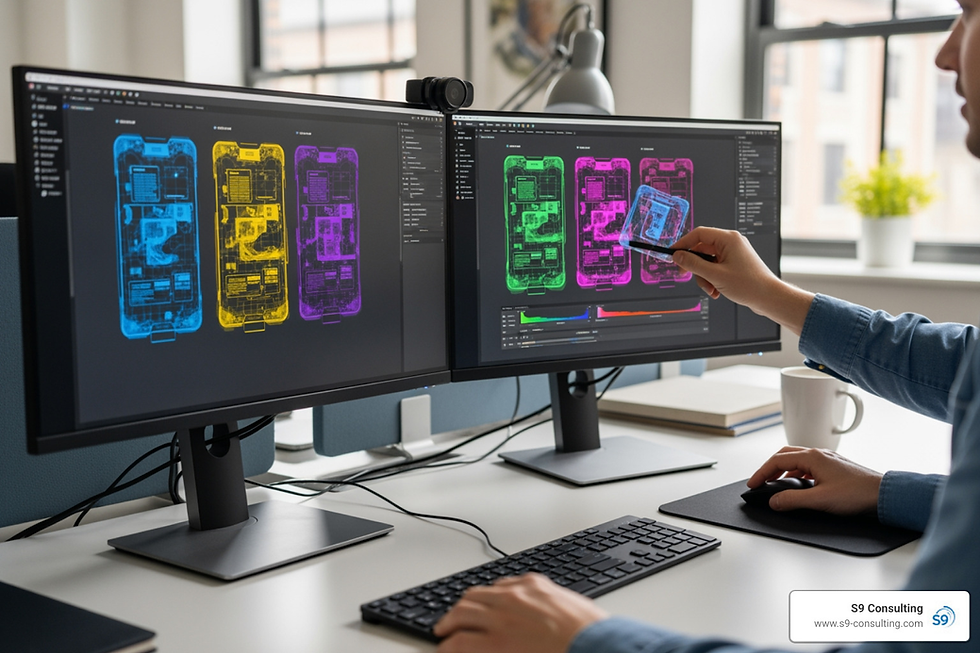
Streamlining Workflows through Web Design with AI
The traditional workflow—research, moodboarding, wireframing, high-fidelity design, and then development—is being compressed into a single, iterative loop.
Generative Ideation: Stuck on a blank canvas? AI can generate dozens of visual concepts based on a single prompt, acting as a high-speed moodboarding assistant.
Wireframe-to-Code: Tools now exist that can take a hand-drawn sketch or a Figma mockup and translate it into clean HTML and CSS.
Instant Deployment: Once the design is approved, many AI builders allow for one-click publishing or seamless export to platforms like WordPress.
By integrating these tools, we can View AI-generated website examples from our portfolio that demonstrate how rapid prototyping doesn't have to mean lower quality. In fact, it often leads to better results because we have more time to test and iterate. If you are looking for a professional web design service, understanding this workflow is key to seeing how modern sites are built for speed and scale.
Key Features of Modern AI Website Builders
If you’re wondering what makes these new tools different from the "automated" builders of five years ago, it comes down to three things: conversational editing, granular control, and intelligence.
Modern web design with AI tools like TeleportHQ or CodeDesign.ai don't just give you a static site. They offer "Conversational Editing," where you can talk to the builder. You might say, "Make the header more modern," or "Change the call-to-action buttons to a sunset orange," and the AI executes the change across the entire site instantly.
Furthermore, these platforms provide granular control. Unlike old-school templates that "broke" if you moved a button two pixels to the left, AI builders generate production-ready code (HTML, CSS, JS) that is fully editable. You get the speed of AI with the precision of a professional developer.
One of the most significant advantages is that these sites are responsive by default. The AI understands how a three-column grid should stack on an iPhone versus a MacBook. This saves hours of manual CSS media query work.
For those using Wix AI integration, the platform can even suggest layout changes based on the specific content you provide, ensuring your brand looks consistent everywhere.
AI Builders vs. Traditional CMS: A Quick Comparison
Feature | AI Website Builders (e.g., CodeDesign) | Traditional CMS (WordPress/Shopify) |
Setup Time | Minutes (Prompt-based) | Hours/Days (Installation & Theme setup) |
Customization | Conversational & Visual | Theme-dependent or Custom Code |
Responsiveness | Automatic AI-optimization | Manual adjustment per breakpoint |
Learning Curve | Low (Natural Language) | Moderate to High |
Maintenance | Integrated/Automated | Manual updates & Plugin management |
Enhancing Accessibility and SEO in Web Design with AI
A beautiful website is useless if no one can find it or if people with disabilities can't use it. This is where web design with AI truly shines.
Accessibility is often an afterthought in traditional design, but AI can automate the "boring" parts of compliance. For example, AI can scan your images and generate descriptive alt-text automatically.
It can also perform real-time contrast checks to ensure your text is readable for users with visual impairments. We always recommend following the WCAG Overview and guidelines to stay compliant, and AI makes that goal much easier to reach.
On the SEO front, we are moving toward Answer Engine Optimization (AEO). AI search engines like Perplexity or Google’s SGE (Search Generative Experience) don't just look for keywords; they look for structured data and clear answers. AI builders help by:
Automatically generating Schema markup.
Optimizing meta tags and headers for semantic relevance.
Structuring content so it is "citeable" by LLMs.
For businesses in Boston looking to stay ahead, utilizing Wix Partner Services for advanced optimization can ensure your AI-assisted site isn't just fast, but also visible in the new age of AI-driven search.
Human vs. Machine: The Nuance of Professional Design
Despite the power of these tools, there is a reason we don't just set the AI to "auto-pilot" and walk away. Web design with AI is a partnership, not a replacement.
AI is fantastic at structure, but it can struggle with nuance. It doesn't understand your specific brand's "voice" or the emotional journey of your customer in the same way a human does. It can also suffer from algorithmic bias, potentially suggesting generic or repetitive layouts that lack the "soul" of a bespoke design.
This is why we advocate for a Human-in-the-loop approach. A designer uses the AI to generate five different layouts, then uses their creative direction to pick the best elements from each, refining the typography, spacing, and imagery to match the brand perfectly. If you're curious about the community discussions on this, the Figma community and best practices groups are great places to see how pros are balancing these two worlds.
When choosing your platform, the level of control matters. For instance, comparing Editor X vs Wix shows that professional designers often prefer tools that allow them to override AI decisions when necessary to maintain perfect brand consistency.
The Future Viability of Web Design with AI
Is the profession of web design dying? Far from it. It is simply evolving.
The "commodity" end of the market—simple five-page sites for local businesses—will likely be dominated by AI. However, the demand for complex, high-performing digital experiences is only growing. Designers who adapt will stop selling "pages" and start selling "outcomes."
As noted in the MDN Web Docs on AI in design, the future belongs to those who can diversify their skills. Instead of just knowing how to use a Pen tool, the modern designer needs to understand prompt engineering, data integration, and how to use AI to solve complex business logic problems.
Overcoming Technical Limitations and Future Trajectory
Current AI technology is impressive, but it’s not magic. There are still limitations when it comes to:
Complex Business Logic: If your site needs a custom-built mortgage calculator that talks to a proprietary API, AI might get the UI right, but a human still needs to wire up the backend.
Custom Functionality: Highly specific interactive features still require manual JavaScript or specialized development.
Data Privacy: Businesses must be careful about what data they feed into AI models. We always look for tools that follow OpenAI Enterprise Privacy standards and offer Zero Data Retention policies to protect our clients' intellectual property.
Looking ahead 5 to 10 years, we expect to see Hyper-personalization. Imagine a website that changes its entire layout, color scheme, and messaging in real-time based on the specific user's behavior and preferences. This level of dynamic design is only possible with AI.
Measuring Success in AI-Assisted Projects
How do you know if your AI-designed site is actually better? You look at the metrics. In our work at S9 Consulting, we track:
Time-to-market: How much faster did we go from concept to launch?
Conversion rates: Is the AI-generated copy and layout driving more sales?
Accessibility scores: Are we hitting 90+ on Lighthouse audits?
User engagement: Are people staying longer because the site is more intuitive?
By using A/B testing, we can pit AI-generated headlines against human-written ones to see which performs better. Often, the winner is a hybrid of both.
Frequently Asked Questions about AI Web Design
What are the pricing models for AI web design tools?
Most tools use a subscription model (monthly/yearly). Some, like CodeDesign.ai, have offered lifetime deals, while others like Elementor AI use a credit-based system where you pay for the number of prompts or images generated. To see how these costs fit into your broader tech stack, you can learn more about AI tool integration for your business.
Can AI-generated websites match human-designed quality?
In terms of visual consistency and structural integrity, yes. In terms of nuanced storytelling and "breaking the rules" of design to create something truly iconic, humans still have the edge. AI is excellent for building high-quality, professional sites that follow established best practices.
Will AI replace professional web designers?
No, but designers who use AI will replace designers who don't. The role is shifting from "creator of every pixel" to "curator and director of AI-generated assets." Strategic oversight and creative partnership remain irreplaceable.
Conclusion
The era of web design with AI isn't just about making things faster; it's about making things better and more accessible for everyone. Whether you are a business owner in Boston or a startup in Boston, MA, USA, these tools allow you to compete at a level that was previously reserved for companies with massive budgets.
At S9 Consulting, we specialize in this exact transition. We don't just build websites; we build long-term digital partnerships focused on process automation, systems integration, and efficiency improvements. We help you navigate the noise and find the right AI tools to scale your business.
Ready to see how AI can transform your digital presence? Start your journey with AI Agents for business and let us help you move from manual coding to intelligent prompting.


