
How to Put Your Business Growth on Autopilot with AI Agents
Updated: May 13
Is Your Business Ready to Scale with AI Agents?

AI agent for business growth is one of the most practical strategies available to small and mid-sized businesses right now. Here's the short answer on how it works:
How AI agents help you scale your business:
Automate repetitive tasks - AI agents handle routine work like lead qualification, order processing, and customer support without human input
Work 24/7 - Unlike human staff, agents never sleep, so your business keeps running after hours
Make faster decisions - Agents analyze data in real time and trigger the right actions instantly
Reduce operating costs - Companies have reported cost reductions of up to 10x in customer service alone
Grow without heavy hiring - Agents let you scale capacity without scaling headcount
Most small business owners hit the same wall. There's too much to do, not enough hours, and not enough people. You're managing customer inquiries, chasing leads, processing orders, and somehow trying to find time to actually grow the business.
AI agents are changing that equation fast.
Unlike basic chatbots or simple automation tools, AI agents can observe what's happening in your business, decide what needs to be done, and act on it — all without waiting for a human to press a button. A global distributor cut order processing time by 60% using agents. A major bank reduced customer service costs by 10 times. These aren't science fiction results — they're happening now, across industries of every size.
The market for AI agents is expected to grow at a 45% CAGR over the next five years, and 88% of senior executives are already planning to increase their AI budgets. The businesses that move early will have a significant edge over those that wait.
I'm Carlos Cortez, senior consultant at S9 Consulting and a revenue-growth strategist with over two decades of experience building and scaling companies across technology, e-commerce, and SaaS. I've seen how the right systems — including AI agent for business growth strategies — can take a company from grinding through manual processes to running on near-autopilot. In this guide, I'll walk you through exactly how to make that shift.
Understanding the AI Agent for Business Growth
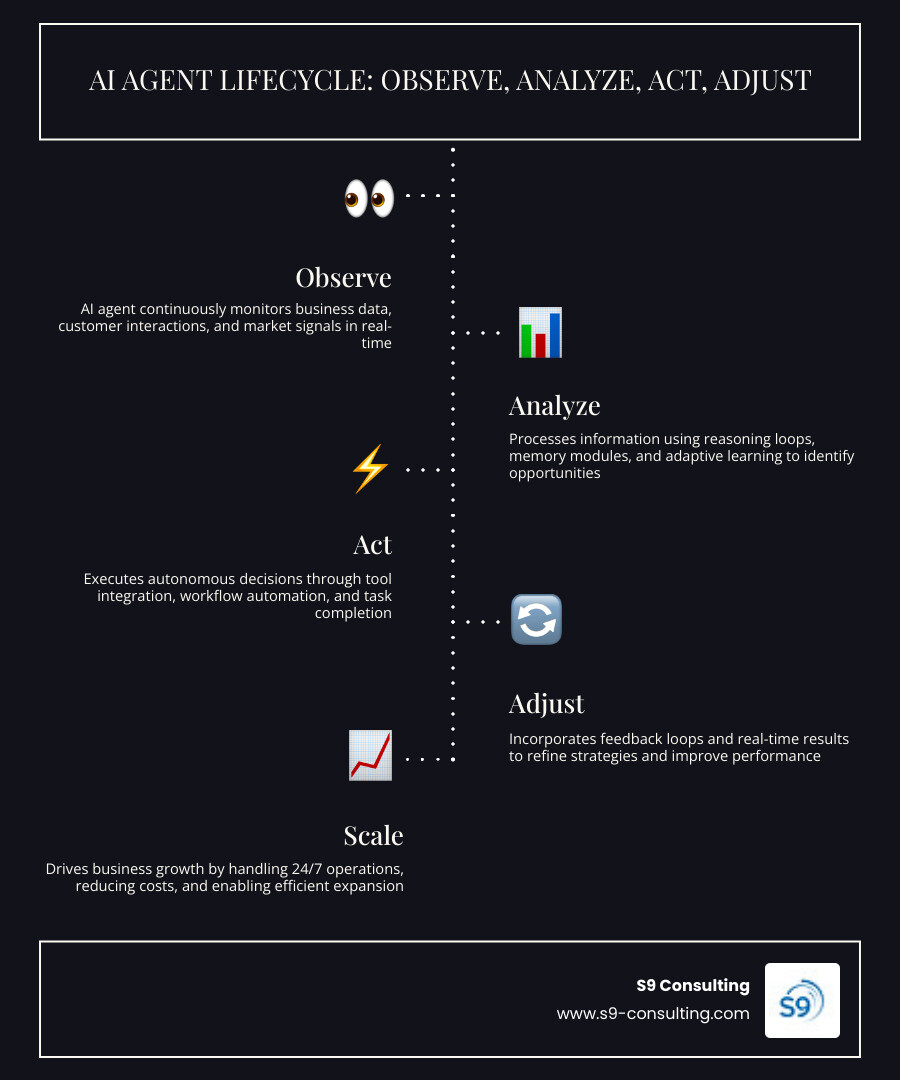
To truly put your growth on autopilot, we first need to understand what makes an AI agent different from the software we’ve used for years. At its core, an AI agent is a system of execution. It doesn't just sit there waiting for you to ask a question; it possesses autonomous traits that allow it to pursue a goal-oriented logic.
Think of it this way: traditional software is like a hammer—it only works when you swing it. An AI agent is like having a skilled carpenter who knows when a nail needs to be driven and just gets it done. According to a PwC survey on executive AI budgets, 88% of leaders are doubling down on this tech because it offers adaptive learning. These agents don't just follow a static script; they analyze data, plan their next moves, and adjust in real-time based on the results they see.

The Evolution from Chatbots to Autonomous Agents
We’ve all interacted with those frustrating chatbots that can’t answer anything outside of a pre-written FAQ. AI agents are the "next phase" of this evolution. By utilizing advanced natural language processing, they can understand complex instructions and participate in workflows just like a human teammate.
When we talk about building AI agents for small business, we are talking about moving from "conversation" to "action." An agent can look at a customer's history, decide they are a high-value lead, and autonomously send them a personalized offer or schedule a meeting in your calendar. They move beyond answering questions to actually executing the tasks that drive revenue.
Core Components of an Effective Agentic System
What's under the hood of an ai agent for business growth? There are five core components that allow them to function:
Profile Module: This defines the agent's role (e.g., "You are a senior sales closer").
Memory Module: This allows the agent to remember past interactions so it doesn't repeat itself and provides better context.
Planning Module: This is where the agent breaks down a large goal ("Increase sales") into smaller, actionable steps.
Action Module: The "hands" of the agent that allow it to send emails, update your CRM, or process a payment.
Feedback Loops: The ability to learn from mistakes and improve performance over time.
Feature | Traditional Automation | Agentic AI |
Logic | If-Then (Rigid) | Goal-Oriented (Adaptive) |
Error Handling | Stops/Breaks | Reasons and Adjusts |
Context | Limited to current task | Broad memory and business context |
Initiative | None (Waits for trigger) | High (Proactive task execution) |
High-Impact Use Cases for Scaling Your Operations
The beauty of AI agents is their versatility. They aren't just for one department; they create an orchestrated ecosystem across your entire company. Whether you are looking for AI solutions for marketing or trying to fix a leaky sales funnel, agents provide the "digital labor" needed to scale.
Recent HubSpot marketing AI statistics show that content creation is a top use case, but the potential goes much deeper. For example, Mastercard uses AI for fraud detection to scan transaction data in milliseconds, identifying suspicious patterns before they become a problem.
Leveraging an AI Agent for Business Growth in Sales
Sales teams are often bogged down by "grunt work"—prospecting, qualifying, and following up. By supercharging your sales pipeline with outbound AI agents, you can turn your sales process into a 24/7 revenue engine.
These agents can scan LinkedIn for leads that match your Ideal Customer Profile (ICP), send tailored outreach emails, and even handle initial objections. In fact, 83% of sales teams using AI saw revenue growth last year, compared to just 66% of those who didn't. By expanding your market presence with AI-assisted lead cultivation, you ensure that no lead ever falls through the cracks. They even assist with pipeline prioritization, telling your human reps exactly who to call first based on the likelihood of closing. The future of AI in sales and customer engagement is one where humans focus on building relationships while agents handle the logistics.
Optimizing Customer Experience with an AI Agent for Business Growth
Customer service is where the ROI of AI agents becomes undeniable. We've seen Klarna's customer service results show that their AI assistant handles two-thirds of all chats, resolving errands in less than 2 minutes compared to the previous 11-minute average.
By streamlining customer support with AI-powered inbound agents, you provide instant, multilingual support that never gets tired or frustrated. These agents use sentiment analysis to detect if a customer is angry and can escalate the issue to a human manager before the situation boils over. They don't just react; they can even predict churn by identifying patterns in customer behavior, allowing you to proactively reach out with a "win-back" offer.
How to Successfully Deploy AI Agents in Your Workflow
Deploying an ai agent for business growth isn't just about "turning it on." It requires a thoughtful redesign of your workflows. You have to treat an AI agent like a new hire: give it a job description, provide the right tools, and monitor its performance.
A Zendesk AI-powered CX Trends Report 2024 highlights that 75% of CX leaders expect support roles to shift toward "AI Managers." This means your team needs to learn how to supervise these digital workers rather than doing the manual tasks themselves.
Identifying High-Value Automation Opportunities
Don't try to automate everything at once. Start by acting as your own AI agent for business analyst to find the bottlenecks. Look for tasks that are:
Repeatable: Something you do every single day.
Data-Heavy: Tasks that involve moving info between spreadsheets or apps.
Time-Sensitive: Things that need to happen fast (like lead follow-up).
Understanding how automation can boost your business processes and increase efficiency starts with ROI mapping. If an agent saves your team 10 hours a week on document review—a result seen by firms that cut review time by 80%—that’s 10 hours they can spend on high-level strategy. For more details, check out a guide to using automation for your business.
Integrating Agents with Existing Tech Stacks
For an agent to be effective, it needs to talk to your existing tools. This is where automating workflows with n8n integration in AI agents becomes vital. Your agent should be connected to your CRM (like Salesforce or HubSpot) and your communication tools.
For example, enhancing outbound communication with Twilio and SendGrid allows your AI agent to send text messages or emails automatically based on customer actions. This API orchestration ensures that your data stays synced across all platforms, preventing the "data silos" that often kill business growth.
Overcoming Challenges and Mitigating Risks
While the benefits are massive, we have to be realistic about the risks. A Mercer poll on employee job concerns found that 40% of employees are worried about job loss due to AI. As business leaders, our job is to frame agents as "teammates" that handle the "boring stuff" so humans can do more meaningful work.
There are also technical hurdles like integration debt and algorithmic bias. This is why harnessing the power of OpenAI and Anthropic in AI agent development requires a focus on "Responsible AI." You can't just set an agent loose; you need guardrails.
Ensuring Data Security and Compliance
When you give an AI agent access to your business data, security is paramount. You need:
Encryption Standards: Ensuring data is safe both at rest and in transit.
Access Controls: Only giving the agent the specific data it needs to do its job.
Audit Trails: Keeping a log of every action the agent takes so you can review it later.
We recommend following strict ethical AI frameworks to ensure your agents aren't accidentally discriminating or mishandling sensitive customer information.
Managing the Human-AI Workforce Transition
The shift to an agentic workforce is as much about people as it is about technology. We’ve seen that 66% of people using AI agents reported higher productivity. To get there, you need a change management plan. Train your staff to become "AI Managers." Instead of fearing the tool, they should learn how to prompt it, audit its work, and use the insights it generates to make better business decisions.
Frequently Asked Questions about AI Agents
What is the difference between an AI agent and a traditional chatbot?
A traditional chatbot follows a fixed script and can only answer specific questions. An AI agent is autonomous; it can reason, plan, and take actions across different software systems to achieve a specific goal without human intervention.
How do AI agents drive measurable business growth?
They drive growth by increasing capacity without increasing headcount. By automating lead generation, sales follow-ups, and customer support, they allow your business to handle 10x the volume at a fraction of the cost. Statistics show that AI-driven personalization alone can increase revenue by 5-8%.
What are the first steps to implementing AI agents in a small business?
Start by identifying one repeatable, high-value process—like qualifying inbound leads. Connect an AI agent to your CRM and email system, set clear rules for its behavior, and monitor its performance for a few weeks before scaling to other departments.
Conclusion
Putting your business growth on autopilot is no longer a luxury reserved for Fortune 500 companies. With ai agent for business growth strategies, small and mid-sized businesses in Boston can now compete at a global scale.
At S9 Consulting, we specialize in this kind of digital transformation. We don't just hand you a piece of software; we become your long-term partner for process automation, systems integration, and operational efficiency. Whether you need to modernize your e-commerce platform or deploy a fleet of custom AI agents, we have the expertise to make it happen.
Ready to stop grinding and start growing? Put your growth on autopilot with S9 Consulting AI Agents today.