A Practical Guide to Comparing Ecommerce Web Design Services
Choose Ecommerce Web Designing Services That Make Buying Easy

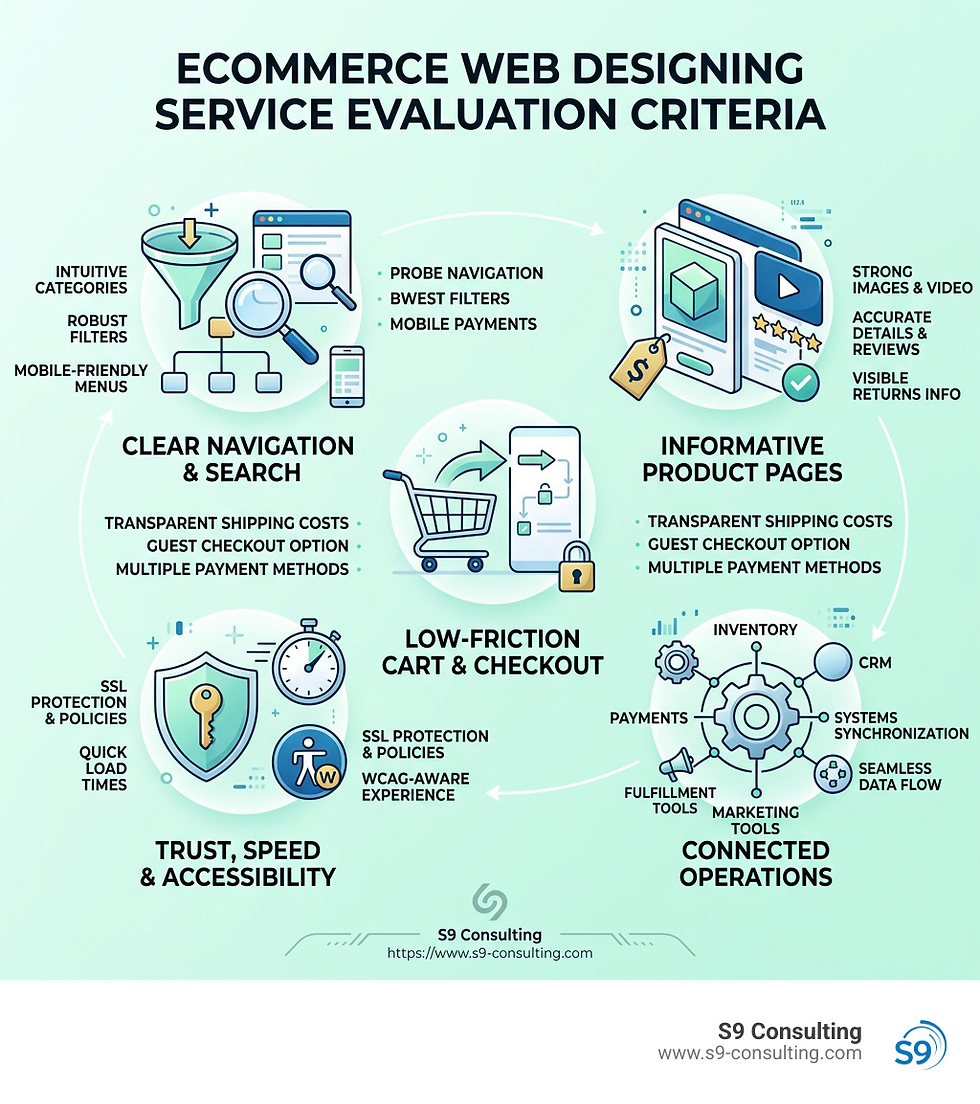
The best ecommerce web designing services do more than make a store look modern. They create a fast, trustworthy buying path: customers can find products, understand what they are buying, see the full cost, pay securely, and get help without leaving checkout.
When comparing providers, look for proof that they can deliver:
Clear navigation and search with useful categories, filters, and mobile-friendly menus.
Product pages that answer buying questions through strong images, video, accurate details, reviews, and visible returns information.
Low-friction cart and checkout flows with transparent shipping costs, guest checkout, several payment methods, and helpful error messages.
Trust, speed, and accessibility including SSL protection, policy pages, responsive design, quick load times, and WCAG-aware experiences.
Connected operations that integrate the storefront with inventory, CRM, payments, fulfillment, and marketing tools.
This matters because visitors form an opinion of a website in about 50 milliseconds. A polished homepage cannot make up for confusing filters, weak product visuals, surprise shipping fees, or a checkout that asks for too much information. Your website is not simply a catalog. It is the digital version of the sales floor, service desk, and checkout counter.
I am Carlos Cortez, a technology and business consultant who has built and scaled e-commerce operations, web platforms, CRM systems, and automated workflows for growth-focused companies. In this guide, I will show you how to compare ecommerce web designing services based on the customer experience, technical capability, and long-term business value they can create.
Core Capabilities of Top Ecommerce Web Designing Services

When running an online store, aesthetics alone will not move the needle. A digital storefront must function as a high-performance sales engine. Selecting the right team means looking past glossy portfolios to evaluate how their technical builds handle real consumer behavior, multi-channel consistency, and enterprise security.
Frictionless Site Navigation and Architecture
Shoppers should never have to wonder where to go next. If a customer cannot find what they want in two or three clicks, they bounce. Top design teams structure product catalogs with clear parent-child taxonomy, intuitive visual breadcrumbs, and faceted product filtering that lets users narrow down options by size, color, material, price, and availability instantly.
A persistent, predictive search bar with auto-complete and typo tolerance is non-negotiable. It acts as a personal shopping assistant for high-intent visitors who know exactly what they need. Advanced search setups also incorporate synonym matching and visual thumbnail previews within the dropdown, dramatically accelerating the time from search query to checkout. To establish a layout that balances discovery with speed, explore our comprehensive web design services tailored to simplify catalog architecture.
Trust Signals, Security Badges, and Customer Confidence
Online shopping requires buyers to hand over sensitive personal and financial details. Trust seals, SSL certificates, and recognizable payment badges act as psychological reassurances that protect conversions. Design agencies must seamlessly weave these trust signals across the entire journey—from product pages to final payment screens.
Equally important are verified customer reviews, clear return windows, shipping policies, and easily accessible business contact details. Displaying transparent policies directly reduces hesitation and cart drop-offs. Adhering to recognized standards such as the Web Content Accessibility Guidelines (WCAG) further ensures that every customer, regardless of device or ability, experiences an inclusive and seamless buying journey. Partnering with the best e-commerce website design service ensures your platform establishes instant credibility the moment a shopper lands on your domain.
Mobile Responsiveness and Cross-Channel Cohesion
Mobile traffic accounts for the vast majority of e-commerce browsing, yet mobile cart abandonment remains notoriously high due to clunky touch targets and bloated layouts. Skilled designers prioritize mobile viewport optimization, ensuring touch-friendly buttons, sticky "Add to Cart" bars, and simplified form fields.
Consistent branding across desktop, mobile, social shops, and email campaigns creates an uninterrupted experience. This requires careful asset optimization, dynamic viewports, and native gesture support like swipeable image carousels. For a complete breakdown of cross-device technical standards, review our e-commerce website design guide.
Essential UX and Conversion Strategies to Look For
To transform casual visitors into loyal buyers, agency partners must implement data-driven user experience (UX) strategies that reduce cognitive load at every stage of the funnel.
Feature | Standard Design Element | High-Converting UX Strategy |
Product Discovery | Static product lists with basic pagination | Dynamic faceted search, autocomplete, and quick-view modals |
Product Media | Flat single-angle static photography | Multi-angle galleries, 360° interactive viewers, and in-use video demos |
Cart Experience | Page redirect to standalone cart page | Slide-out mini-cart with real-time tax/shipping estimates |
Checkout Process | Multi-step mandatory account creation | Single-page guest checkout with instant address autofill |
Trust Building | Basic footer policy links | Prominent security badges, verified reviewer details, and transparent guarantees |
High-Converting Product Page Architecture
Online shoppers lack the tactile experience of holding a product in their hands. Product pages must bridge that sensory gap. Top-tier agencies implement high-resolution galleries, white-background zoom tools, 360-degree interactive viewers, and lifestyle video demonstrations. Research shows that interactive product views can reduce return rates significantly by setting accurate expectations.
Persuasive design elements like scarcity indicators—such as low-stock alerts or countdown timers for limited promotions—naturally tap into shopper psychology without feeling deceptive. Furthermore, incorporating user-generated content, customer photos, and clear sizing charts gives shoppers complete clarity before purchasing. Learn practical methods for boosting catalog performance in our e-commerce product page optimization guide.

Shopping Cart and Checkout Friction Reduction
Unexpected shipping costs are one of the leading reasons shoppers abandon their shopping carts. To counter this, elite designers incorporate slide-out mini-cart widgets featuring dynamic shipping calculators and item edit controls right on the active page.
Checkout flows should default to guest checkout, require minimal form inputs, offer one-click express payment options (Apple Pay, Google Pay, Shop Pay), and display real-time inline form validation to prevent frustrating error messages. Integrating live chat assistance directly within checkout provides immediate answers when a customer hesitates at the final step, capturing revenue that would otherwise be lost.
Persuasive Design and Visual Hierarchy
Visual hierarchy directs the user's eye naturally toward primary actions. High-converting layouts balance white space, contrasting call-to-action (CTA) styling, clear typography, and subtle micro-interactions that confirm user inputs. Dive deeper into visual optimization strategies with our web design for e-commerce guide.
Key Evaluation Criteria When Hiring an Agency

Selecting an agency requires auditing their technical capabilities, platform mastery, and operational integration skills.
Why Specialized Ecommerce Web Designing Services Outperform Generalists
Generalist marketing agencies often treat e-commerce sites like standard content websites. However, an online store involves intricate catalog logic, checkout API security, payment gateways, automated tax calculations, and fulfillment routing.
Specialists understand platform-specific nuances inside out. They know how to structure theme templates to prevent script bloat and maintain rapid rendering speeds. If you are building on Shopify, partnering with experienced Shopify website design agencies guarantees proper liquid theme development, lightning-fast script loading, and app stack optimization without unnecessary bloat.
Assessing Technical Stack and Ecommerce Web Designing Services
Your digital storefront does not operate in isolation. It must communicate seamlessly with your enterprise resource planning (ERP) system, inventory management databases, CRM tools, and fulfillment partners.
When vetting agencies, verify their ability to optimize Core Web Vitals, write clean semantic code, manage complex APIs, and handle complete store configurations like our turnkey Shopify end-to-end setup.
Frequently Asked Questions About E-Commerce Design
What is the typical cost structure for custom e-commerce web design?
Costs depend on catalog complexity, custom UI/UX requirements, third-party backend integrations, and custom application logic. Agencies generally price projects through fixed-scope milestones or monthly retainers that combine initial architecture with ongoing conversion rate optimization (CRO) and maintenance.
How does UX design directly impact e-commerce conversion rates?
Strategic UX design removes friction from product discovery, page load speeds, and checkout steps. By simplifying navigation, clarifying product details, and removing surprise costs, a well-designed UX directly lowers bounce rates, lifts average order value (AOV), and drives repeat customer lifetime value.
How long does a standard e-commerce website redesign project take?
A full-scale custom redesign typically spans 8 to 16 weeks. This timeline includes discovery, audience research, wireframing, high-fidelity UI prototyping, custom development, ERP/CRM integrations, rigorous quality assurance, and user acceptance testing prior to public launch.
Conclusion
Choosing the right design partner shapes your business growth for years to come. When comparing potential agencies:
Audit their past builds for mobile responsiveness, page speed, and navigation clarity.
Verify their technical expertise in integrating ERPs, CRMs, and payment gateways.
Ensure their UX design focuses on transparent pricing, trust signals, and streamlined checkout flows.
Look for long-term partners who prioritize ongoing performance, process automation, and systems scalability.
At S9 Consulting, with teams in Boston, MA and Jacksonville, FL, we deliver scalable digital solutions, deep systems integration, and automated workflows designed to accelerate business efficiency. Discover how our team builds high-performing storefronts with our dedicated web design for e-commerce businesses.